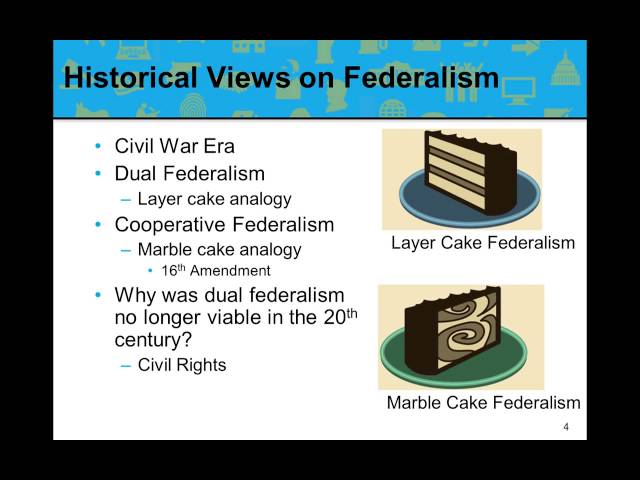
Individuals who take a “layer cake” view of federalism consider that the federal authorities and state governments have distinct and separate powers. This view relies on the concept the Structure created two sovereign entities, every with its personal powers and tasks. Proponents of this view argue that the federal authorities needs to be restricted to these powers which are particularly delegated to it by the Structure, whereas the states ought to retain all different powers.
The “layer cake” view of federalism has been influential in American historical past. It was the dominant view through the early years of the republic, and it has continued to be a major pressure in American politics. Nonetheless, the “layer cake” view has additionally been challenged by different theories of federalism, such because the “marble cake” view and the “cooperative federalism” view. These theories argue that the federal and state governments are extra interdependent than the “layer cake” view suggests.
Regardless of these challenges, the “layer cake” view of federalism stays an necessary perspective on the American political system. It supplies a transparent and concise framework for understanding the connection between the federal authorities and the states, and it has been used to justify a variety of insurance policies and selections.
Individuals who take a “layer cake” view of federalism consider that
Individuals who take a “layer cake” view of federalism consider that the federal authorities and state governments have distinct and separate powers. This view relies on the concept the Structure created two sovereign entities, every with its personal powers and tasks. Proponents of this view argue that the federal authorities needs to be restricted to these powers which are particularly delegated to it by the Structure, whereas the states ought to retain all different powers.
- Restricted federal authorities: The federal authorities ought to have solely these powers which are particularly delegated to it by the Structure.
- Robust state governments: The states ought to retain all powers not delegated to the federal authorities.
- Twin sovereignty: The federal authorities and state governments are each sovereign entities.
- Strict building of the Structure: The Structure needs to be interpreted narrowly to restrict the powers of the federal authorities.
- Reserved powers: The states have all powers not delegated to the federal authorities.
- Separation of powers: The federal authorities and state governments ought to have separate and distinct powers.
- Checks and balances: The federal authorities and state governments ought to have checks and balances on one another’s energy.
- Federalism: Federalism is a system of presidency wherein energy is split between a central authorities and regional governments.
- Layer cake federalism: Layer cake federalism is a kind of federalism wherein the federal authorities and state governments have distinct and separate powers.
- Marble cake federalism: Marble cake federalism is a kind of federalism wherein the federal authorities and state governments have overlapping and shared powers.
The “layer cake” view of federalism has been influential in American historical past. It was the dominant view through the early years of the republic, and it has continued to be a major pressure in American politics. Nonetheless, the “layer cake” view has additionally been challenged by different theories of federalism, such because the “marble cake” view and the “cooperative federalism” view. These theories argue that the federal and state governments are extra interdependent than the “layer cake” view suggests.
Regardless of these challenges, the “layer cake” view of federalism stays an necessary perspective on the American political system. It supplies a transparent and concise framework for understanding the connection between the federal authorities and the states, and it has been used to justify a variety of insurance policies and selections.
Restricted federal authorities
This precept is a key element of the “layer cake” view of federalism, which holds that the federal authorities and state governments have distinct and separate powers. Proponents of this view argue that the federal authorities needs to be restricted to these powers which are particularly delegated to it by the Structure, whereas the states ought to retain all different powers.
The precept of restricted federal authorities relies on the concept the Structure created two sovereign entities, every with its personal powers and tasks. This view is in step with the Framers’ intent to create a system of presidency wherein energy is split between the federal authorities and the states. By limiting the powers of the federal authorities, the Framers sought to forestall the federal authorities from turning into too highly effective and encroaching on the rights of the states and the folks.
The precept of restricted federal authorities has been upheld by the Supreme Courtroom in quite a few circumstances. In McCulloch v. Maryland (1819), the Courtroom held that the federal authorities solely has these powers which are particularly delegated to it by the Structure. In United States v. Lopez (1995), the Courtroom held that the Gun-Free Faculty Zones Act of 1990 was unconstitutional as a result of it exceeded the powers delegated to the federal authorities by the Commerce Clause. These circumstances exhibit the Courtroom’s dedication to the precept of restricted federal authorities.
The precept of restricted federal authorities is a vital safeguard for particular person liberty and state sovereignty. By limiting the powers of the federal authorities, the Structure ensures that the states and the folks retain a major diploma of autonomy. This division of energy helps to forestall the federal authorities from turning into too highly effective and encroaching on the rights of the states and the folks.
Robust state governments
The precept of sturdy state governments is a key element of the “layer cake” view of federalism, which holds that the federal authorities and state governments have distinct and separate powers. Proponents of this view argue that the states ought to retain all powers not delegated to the federal authorities, with a view to shield particular person liberty and state sovereignty.
The precept of sturdy state governments relies on the concept the states are the first guardians of particular person rights and state sovereignty. This view is in step with the Framers’ intent to create a system of presidency wherein energy is split between the federal authorities and the states. By giving the states all powers not delegated to the federal authorities, the Framers sought to make sure that the states would retain a major diploma of autonomy.
The precept of sturdy state governments has been upheld by the Supreme Courtroom in quite a few circumstances. In McCulloch v. Maryland (1819), the Courtroom held that the federal authorities solely has these powers which are particularly delegated to it by the Structure. In United States v. Lopez (1995), the Courtroom held that the Gun-Free Faculty Zones Act of 1990 was unconstitutional as a result of it exceeded the powers delegated to the federal authorities by the Commerce Clause. These circumstances exhibit the Courtroom’s dedication to the precept of sturdy state governments.
The precept of sturdy state governments is a vital safeguard for particular person liberty and state sovereignty. By giving the states all powers not delegated to the federal authorities, the Structure ensures that the states retain a major diploma of autonomy. This division of energy helps to forestall the federal authorities from turning into too highly effective and encroaching on the rights of the states and the folks.
In recent times, there was a rising motion to strengthen state governments. This motion relies on the idea that the federal authorities has change into too highly effective and that the states have to be extra assertive in defending their rights and the rights of their residents. This motion has been profitable in passing a variety of legal guidelines which have strengthened state governments, such because the Actual ID Act of 2005 and the Affected person Safety and Inexpensive Care Act of 2010.
Twin sovereignty
The precept of twin sovereignty is a key element of the “layer cake” view of federalism. This view holds that the federal authorities and state governments are each sovereign entities, every with its personal powers and tasks. Proponents of this view argue that this division of energy is crucial to guard particular person liberty and state sovereignty.
- Shared powers: The federal authorities and state governments share some powers, equivalent to the ability to tax and the ability to control commerce. Nonetheless, every stage of presidency has its personal distinctive powers as nicely.
- Concurrent powers: The federal authorities and state governments have concurrent powers in some areas, equivalent to the ability to control public well being and security. Which means each ranges of presidency can cross legal guidelines in these areas, however the federal authorities’s legal guidelines will prevail if there’s a battle.
- Reserved powers: The states have all powers that aren’t delegated to the federal authorities or prohibited by the Structure. These powers embody the ability to control intrastate commerce, the ability to ascertain native governments, and the ability to set felony legal guidelines.
The precept of twin sovereignty is a vital safeguard for particular person liberty and state sovereignty. By dividing energy between the federal authorities and the states, the Structure ensures that neither stage of presidency turns into too highly effective. This division of energy helps to guard particular person rights and state autonomy.
Strict building of the Structure
The precept of strict building of the Structure is intently related to the “layer cake” view of federalism. Proponents of the “layer cake” view consider that the federal authorities ought to have solely these powers which are particularly delegated to it by the Structure, whereas the states ought to retain all different powers. Strict building of the Structure is a approach of deciphering the Structure in a approach that limits the powers of the federal authorities and protects the powers of the states.
- Authentic intent: Strict constructionists consider that the Structure needs to be interpreted based on the unique intent of the Framers. Which means they give the impression of being to the textual content of the Structure and the historic report to find out the which means of the Structure’s provisions.
- Restricted powers: Strict constructionists consider that the federal authorities ought to have solely these powers which are particularly delegated to it by the Structure. They argue that any powers not particularly delegated to the federal authorities are reserved to the states or the folks.
- State sovereignty: Strict constructionists consider that the states are sovereign entities and that the federal authorities mustn’t intrude with their powers. They argue that the Structure creates a system of twin sovereignty, wherein the federal authorities and the states have separate and distinct powers.
The precept of strict building of the Structure has been used to restrict the powers of the federal authorities in a variety of circumstances. For instance, within the case of Marbury v. Madison (1803), the Supreme Courtroom held that the federal authorities didn’t have the ability to create new courts as a result of that energy was not particularly delegated to it by the Structure. Within the case of United States v. Lopez (1995), the Supreme Courtroom held that the Gun-Free Faculty Zones Act of 1990 was unconstitutional as a result of it exceeded the powers delegated to the federal authorities by the Commerce Clause.
The precept of strict building of the Structure is a controversial one. Critics argue that it’s too restrictive and that it prevents the federal authorities from successfully addressing nationwide issues. Nonetheless, proponents of strict building argue that it’s important to defending the powers of the states and the rights of the folks.
Reserved powers
The precept of reserved powers is a key element of the “layer cake” view of federalism. This view holds that the federal authorities ought to have solely these powers which are particularly delegated to it by the Structure, whereas the states ought to retain all different powers. The precept of reserved powers relies on the concept the states are the first guardians of particular person rights and state sovereignty. By giving the states all powers not delegated to the federal authorities, the Framers sought to make sure that the states would retain a major diploma of autonomy.
The precept of reserved powers has been upheld by the Supreme Courtroom in quite a few circumstances. In McCulloch v. Maryland (1819), the Courtroom held that the federal authorities solely has these powers which are particularly delegated to it by the Structure. In United States v. Lopez (1995), the Courtroom held that the Gun-Free Faculty Zones Act of 1990 was unconstitutional as a result of it exceeded the powers delegated to the federal authorities by the Commerce Clause. These circumstances exhibit the Courtroom’s dedication to the precept of reserved powers.
The precept of reserved powers is a vital safeguard for particular person liberty and state sovereignty. By giving the states all powers not delegated to the federal authorities, the Structure ensures that the states retain a major diploma of autonomy. This division of energy helps to forestall the federal authorities from turning into too highly effective and encroaching on the rights of the states and the folks.
In recent times, there was a rising motion to strengthen the precept of reserved powers. This motion relies on the idea that the federal authorities has change into too highly effective and that the states have to be extra assertive in defending their rights and the rights of their residents. This motion has been profitable in passing a variety of legal guidelines which have strengthened the precept of reserved powers, such because the Actual ID Act of 2005 and the Affected person Safety and Inexpensive Care Act of 2010.
Separation of powers
The precept of separation of powers is a key element of the “layer cake” view of federalism. This view holds that the federal authorities and state governments ought to have separate and distinct powers with a view to stop anyone department of presidency from turning into too highly effective.
The precept of separation of powers relies on the concept the totally different branches of presidency ought to have totally different features. The legislative department ought to make legal guidelines, the chief department ought to implement legal guidelines, and the judicial department ought to interpret legal guidelines. By separating these powers, the Framers sought to create a system of presidency wherein nobody department might change into too highly effective.
The precept of separation of powers has been upheld by the Supreme Courtroom in quite a few circumstances. In Marbury v. Madison (1803), the Courtroom held that the judicial department has the ability to declare legal guidelines unconstitutional. In United States v. Nixon (1974), the Courtroom held that the President shouldn’t be immune from felony prosecution. These circumstances exhibit the Courtroom’s dedication to the precept of separation of powers.
The precept of separation of powers is a vital safeguard for particular person liberty and the rule of legislation. By separating the powers of presidency, the Structure ensures that nobody department can change into too highly effective and that the rights of the individuals are protected.
Checks and balances
The precept of checks and balances is intently related to the “layer cake” view of federalism. Proponents of the “layer cake” view consider that the federal authorities and state governments ought to have distinct and separate powers, and that every stage of presidency ought to have checks and balances on the opposite’s energy. This method of checks and balances is designed to forestall anyone department of presidency from turning into too highly effective.
- Separation of powers: The precept of separation of powers is a key element of the system of checks and balances. This precept holds that the totally different branches of presidency ought to have totally different features. The legislative department ought to make legal guidelines, the chief department ought to implement legal guidelines, and the judicial department ought to interpret legal guidelines. By separating these powers, the Framers sought to create a system of presidency wherein nobody department might change into too highly effective.
- Judicial evaluation: The precept of judicial evaluation is one other necessary element of the system of checks and balances. This precept provides the courts the ability to declare legal guidelines unconstitutional. This energy helps to make sure that the opposite branches of presidency don’t overstep their authority.
- Federalism: The precept of federalism can also be a key element of the system of checks and balances. This precept divides energy between the federal authorities and the state governments. This division of energy helps to forestall the federal authorities from turning into too highly effective.
The system of checks and balances is a necessary a part of the American system of presidency. It helps to make sure that nobody department of presidency turns into too highly effective and that the rights of the individuals are protected.
Federalism
Federalism is a system of presidency wherein energy is split between a central authorities and regional governments. This division of energy can take many various types, but it surely usually entails the central authorities having duty for nationwide issues, equivalent to overseas coverage and protection, whereas the regional governments are answerable for native issues, equivalent to schooling and healthcare.
- Shared powers: In a federal system, each the central authorities and the regional governments usually have some powers that they share. For instance, each the central authorities and the regional governments could have the ability to tax and to control commerce.
- Concurrent powers: In a federal system, the central authorities and the regional governments may have some powers that they train concurrently. For instance, each the central authorities and the regional governments could have the ability to control environmental safety.
- Reserved powers: In a federal system, the regional governments usually have some powers which are reserved to them. These powers aren’t shared with the central authorities, they usually can’t be exercised by the central authorities.
The “layer cake” view of federalism is a idea of federalism that emphasizes the separation of powers between the central authorities and the regional governments. Proponents of the “layer cake” view consider that the central authorities ought to have solely these powers which are particularly delegated to it by the structure, whereas the regional governments ought to retain all different powers. This view of federalism relies on the concept the states are the first items of presidency and that the federal authorities ought to solely have restricted powers.
The “layer cake” view of federalism has been influential in American historical past. It was the dominant view of federalism through the early years of the republic, and it continues to be a major pressure in American politics at the moment.
Layer cake federalism
Layer cake federalism is a kind of federalism wherein the federal authorities and state governments have distinct and separate powers. This view of federalism relies on the concept the Structure created two sovereign entities, every with its personal powers and tasks. Proponents of layer cake federalism argue that the federal authorities needs to be restricted to these powers which are particularly delegated to it by the Structure, whereas the states ought to retain all different powers.
Individuals who take a “layer cake” view of federalism consider that the federal authorities ought to have solely these powers which are particularly delegated to it by the Structure, whereas the states ought to retain all different powers. This view of federalism relies on the concept the states are the first items of presidency and that the federal authorities ought to solely have restricted powers.
The layer cake view of federalism has been influential in American historical past. It was the dominant view of federalism through the early years of the republic, and it continues to be a major pressure in American politics at the moment. Nonetheless, the layer cake view of federalism has additionally been challenged by different theories of federalism, such because the “marble cake” view and the “cooperative federalism” view. These theories argue that the federal and state governments are extra interdependent than the layer cake view suggests.
Regardless of these challenges, the layer cake view of federalism stays an necessary perspective on the American political system. It supplies a transparent and concise framework for understanding the connection between the federal authorities and the states, and it has been used to justify a variety of insurance policies and selections.
Marble cake federalism
Marble cake federalism is a kind of federalism wherein the federal authorities and state governments have overlapping and shared powers. That is in distinction to layer cake federalism, which holds that the federal authorities and state governments have distinct and separate powers. Proponents of marble cake federalism argue that this technique is extra versatile and permits the federal authorities and state governments to work collectively to handle complicated points.
One key distinction between layer cake federalism and marble cake federalism is the best way that powers are allotted between the federal authorities and the state governments. In layer cake federalism, the federal authorities has solely these powers which are particularly delegated to it by the Structure, whereas the states retain all different powers. In marble cake federalism, nonetheless, the federal authorities and the state governments share many powers. Which means each ranges of presidency can cross legal guidelines and laws in the identical areas, equivalent to environmental safety and schooling.
One other key distinction between layer cake federalism and marble cake federalism is the best way that disputes between the federal authorities and the state governments are resolved. In layer cake federalism, disputes are usually resolved by means of the courts. In marble cake federalism, nonetheless, disputes are sometimes resolved by means of negotiation and compromise between the 2 ranges of presidency.
Marble cake federalism has been the dominant mannequin of federalism in the USA for the reason that New Deal period. It’s because the New Deal concerned a major enlargement of the federal authorities’s function within the financial system and society. Because of this, the federal authorities and the state governments now share many powers, equivalent to the ability to control commerce, the ability to tax, and the ability to offer social welfare packages.
Marble cake federalism has each benefits and drawbacks. One benefit is that it permits the federal authorities and the state governments to work collectively to handle complicated points. For instance, the federal authorities and the state governments have labored collectively to handle points equivalent to local weather change, healthcare, and schooling.
One drawback of marble cake federalism is that it might result in battle between the federal authorities and the state governments. For instance, the federal authorities and the state governments have clashed over points equivalent to environmental regulation, gun management, and immigration.
General, marble cake federalism is a fancy and evolving system of presidency. It has each benefits and drawbacks, and it’s prone to proceed to be the dominant mannequin of federalism in the USA for the foreseeable future.
FAQs
This part supplies solutions to steadily requested questions concerning the “layer cake” view of federalism.
Query 1: What’s the “layer cake” view of federalism?
The “layer cake” view of federalism is a idea that emphasizes the separation of powers between the federal authorities and the state governments. Proponents of this view consider that the federal authorities ought to have solely these powers which are particularly delegated to it by the Structure, whereas the states ought to retain all different powers.
Query 2: Why is the “layer cake” view of federalism necessary?
The “layer cake” view of federalism is necessary as a result of it supplies a transparent and concise framework for understanding the connection between the federal authorities and the states. It has additionally been used to justify a variety of insurance policies and selections all through American historical past.
Query 3: What are the benefits of the “layer cake” view of federalism?
The “layer cake” view of federalism has a number of benefits. First, it helps to forestall the federal authorities from turning into too highly effective. Second, it protects the rights of the states. Third, it promotes native autonomy and self-government.
Query 4: What are the disadvantages of the “layer cake” view of federalism?
The “layer cake” view of federalism additionally has some disadvantages. First, it might make it troublesome for the federal authorities to handle nationwide issues. Second, it might result in battle between the federal authorities and the states. Third, it may end up in an absence of uniformity in legal guidelines and laws throughout the nation.
Query 5: Is the “layer cake” view of federalism nonetheless related at the moment?
The “layer cake” view of federalism stays an necessary perspective on the American political system. Though it has been challenged by different theories of federalism, it continues to be a major pressure in American politics and is used to justify quite a lot of insurance policies and selections.
Query 6: What are some examples of the “layer cake” view of federalism in follow?
There are a lot of examples of the “layer cake” view of federalism in follow. For instance, the federal authorities has the ability to control interstate commerce, however the states have the ability to control intrastate commerce. The federal authorities has the ability to declare warfare, however the states have the ability to lift and keep militias. The federal authorities has the ability to coin cash, however the states have the ability to subject their very own foreign money.
Abstract: The “layer cake” view of federalism is a fancy and nuanced idea that has been influential in American historical past. It has each benefits and drawbacks, and it stays a related perspective on the American political system at the moment.
Transition: For extra info on the “layer cake” view of federalism, please see the next sources:
Ideas for Understanding the “Layer Cake” View of Federalism
The “layer cake” view of federalism is a idea that emphasizes the separation of powers between the federal authorities and the state governments. Proponents of this view consider that the federal authorities ought to have solely these powers which are particularly delegated to it by the Structure, whereas the states ought to retain all different powers.
Listed here are 5 suggestions for understanding the “layer cake” view of federalism:
Tip 1: Perceive the idea of twin sovereignty.The “layer cake” view of federalism relies on the idea of twin sovereignty. Which means each the federal authorities and the state governments are sovereign entities, every with its personal powers and tasks.Tip 2: Acknowledge the significance of the Structure.The Structure is the supreme legislation of the land, and it establishes the powers of the federal authorities and the states. Based on the “layer cake” view, the federal authorities solely has these powers which are particularly delegated to it by the Structure.Tip 3: Pay attention to the boundaries on federal energy.The “layer cake” view of federalism limits the powers of the federal authorities. It’s because proponents of this view consider that the states ought to retain all powers not delegated to the federal authorities.Tip 4: Perceive the function of the states.The states play an necessary function within the “layer cake” view of federalism. It’s because the states retain all powers not delegated to the federal authorities.Tip 5: Pay attention to the challenges to the “layer cake” view.The “layer cake” view of federalism has been challenged by different theories of federalism, such because the “marble cake” view and the “cooperative federalism” view. These theories argue that the federal and state governments are extra interdependent than the “layer cake” view suggests.
Abstract: The “layer cake” view of federalism is a fancy and nuanced idea. Nonetheless, by following the following pointers, you’ll be able to achieve a greater understanding of this necessary idea.
Conclusion
The “layer cake” view of federalism is a fancy and nuanced idea that has been influential in American historical past. Proponents of this view consider that the federal authorities ought to have solely these powers which are particularly delegated to it by the Structure, whereas the states ought to retain all different powers. This view of federalism relies on the concept the states are the first items of presidency and that the federal authorities ought to solely have restricted powers.
The “layer cake” view of federalism has been challenged by different theories of federalism, such because the “marble cake” view and the “cooperative federalism” view. These theories argue that the federal and state governments are extra interdependent than the “layer cake” view suggests. Nonetheless, the “layer cake” view stays an necessary perspective on the American political system, and it continues for use to justify quite a lot of insurance policies and selections.
In the end, the “layer cake” view of federalism is a matter of debate. There are sturdy arguments to be made on each side of the difficulty. Nonetheless, by understanding the totally different views on federalism, we are able to higher perceive the complicated relationship between the federal authorities and the states.
Youtube Video: